Press Release | Paige Impink / Tewksbury Town Crier
Students tackle real-world engineering challenges with industry mentors
December 23, 2025
Check out this article about Tewksbury Memorial High School Project Lead The Way students taking part in a One8, hands-on engineering program that connected them directly with industry mentors and real-world challenges.
Source: Tewksbury Town Crier
Authors: Paige Impink, News Correspondent
Date: December 20, 2025
TEWKSBURY — LG-1 and 2 at Tewksbury Memorial High School looked more like professional design studios recently as students took part in a hands-on engineering program that connected them directly with industry mentors and real-world challenges.
As part of the school’s participation in Project Lead the Way, juniors and seniors enrolled in engineering and computer science courses spent the day working on authentic design problems posed by outside organizations. The goal: give students firsthand experience with how engineers collaborate, brainstorm, and develop solutions beyond the classroom.
One group of students focused on a challenge from a global health technology company. Their task was to develop ideas to make a portable medical device easier for healthcare providers to adopt. Students explored improvements such as better training tools, clearer instructions, and creative ways to expand the device’s use into other medical disciplines to benefit more patients.
Working remotely via Zoom, industry mentor Rafael Cordero guided students as they independently developed concepts and then presented their ideas using a document camera. Each group shared its proposals and received direct feedback, mirroring how professional engineering teams review and refine designs.
“I think it gives us a good look into what a real-world problem would be like, and the kinds of things we might experience later in an engineering career,” said student participant Jane Garabedian.
Another student emphasized the value of collaboration.
“It’s a good hands-on experience of talking with a real person, pitching ideas, and brainstorming with the team,” said Sami Al-Sadi. “Teamwork is a big part of engineering, so this really helps us focus on how to work together.”
In addition to the medical device project, engineering students were also tasked with solving a challenge connected to a large nonprofit fundraising organization. That problem asked students to design a tool to help flip inquiries to commitments by when individual participants expressed interest in the event.
The request was to simplify the technical process of matching participants to a fundraising team — reducing the amount of manual work required for the event.
STEM Pathways Coordinator Mary Jo Kelleher, who helped organize the program, said the experience is invaluable for students.
“It’s a great opportunity for them to see what engineering design looks like in the real world, connected with a professional mentor in an industry that has an actual problem,” she said. “That connection makes the work meaningful.”
Computer science teacher Sanford Arbogast echoed that sentiment, noting that students gain insight into how professionals approach complex challenges.
“They get to see how brainstorming works, how ideas are broken down, and how decisions are made about what’s feasible and what’s not,” he said.
Mentor Jonah Wilson said working with students benefits professionals as well.
“Having younger minds working on problems we don’t always have time to solve is invaluable,” he said. “I’m excited to hear what they bring to the table.”
For many students, the program offered a glimpse into potential future careers in engineering and technology — and a reminder that the skills they are learning now can have real-world impact.
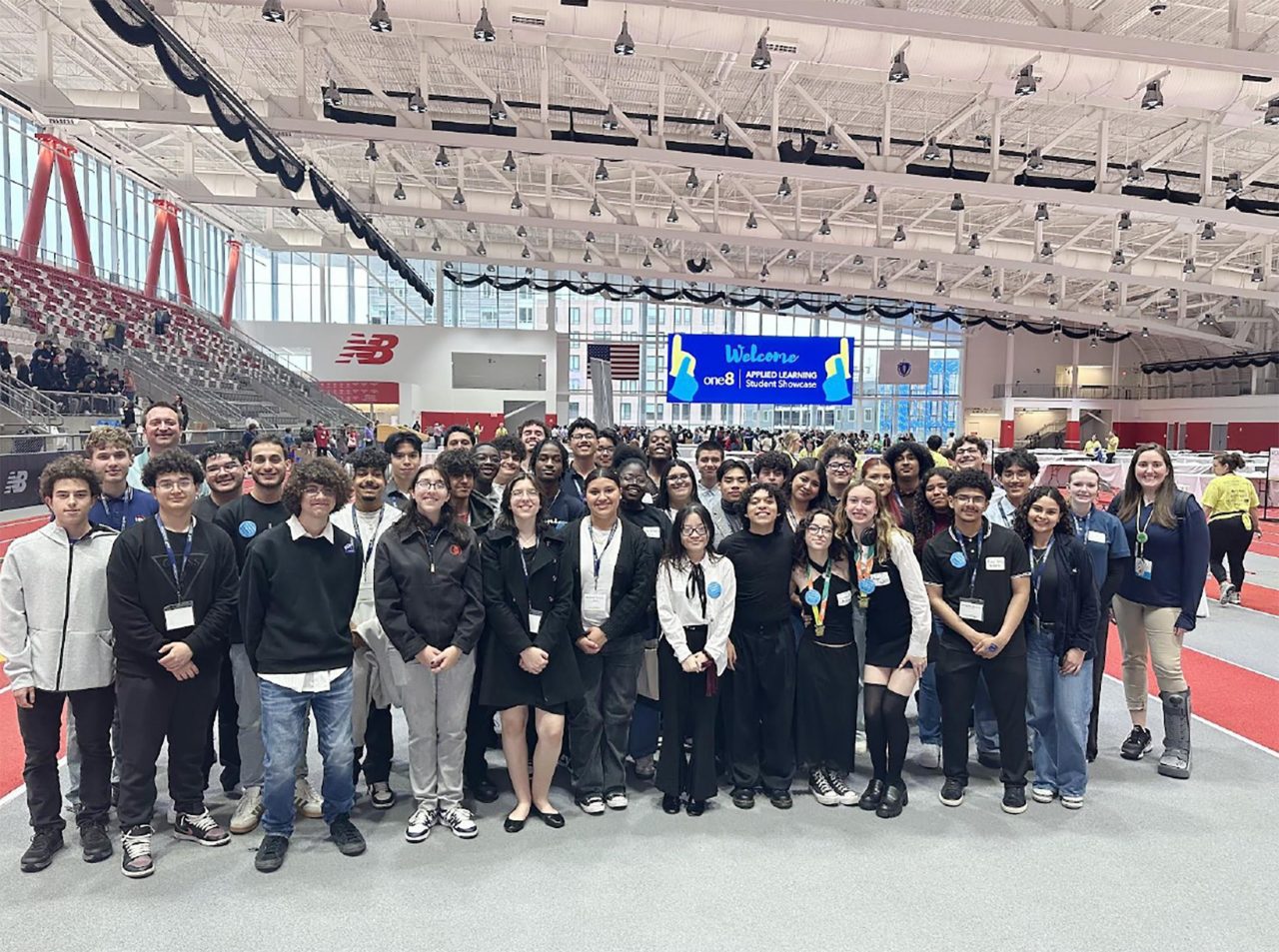
The program is part of One8 Applied Learning Hub as part of the Student Solve program. The exercise was conducted in a host of public high schools across the Commonwealth.